
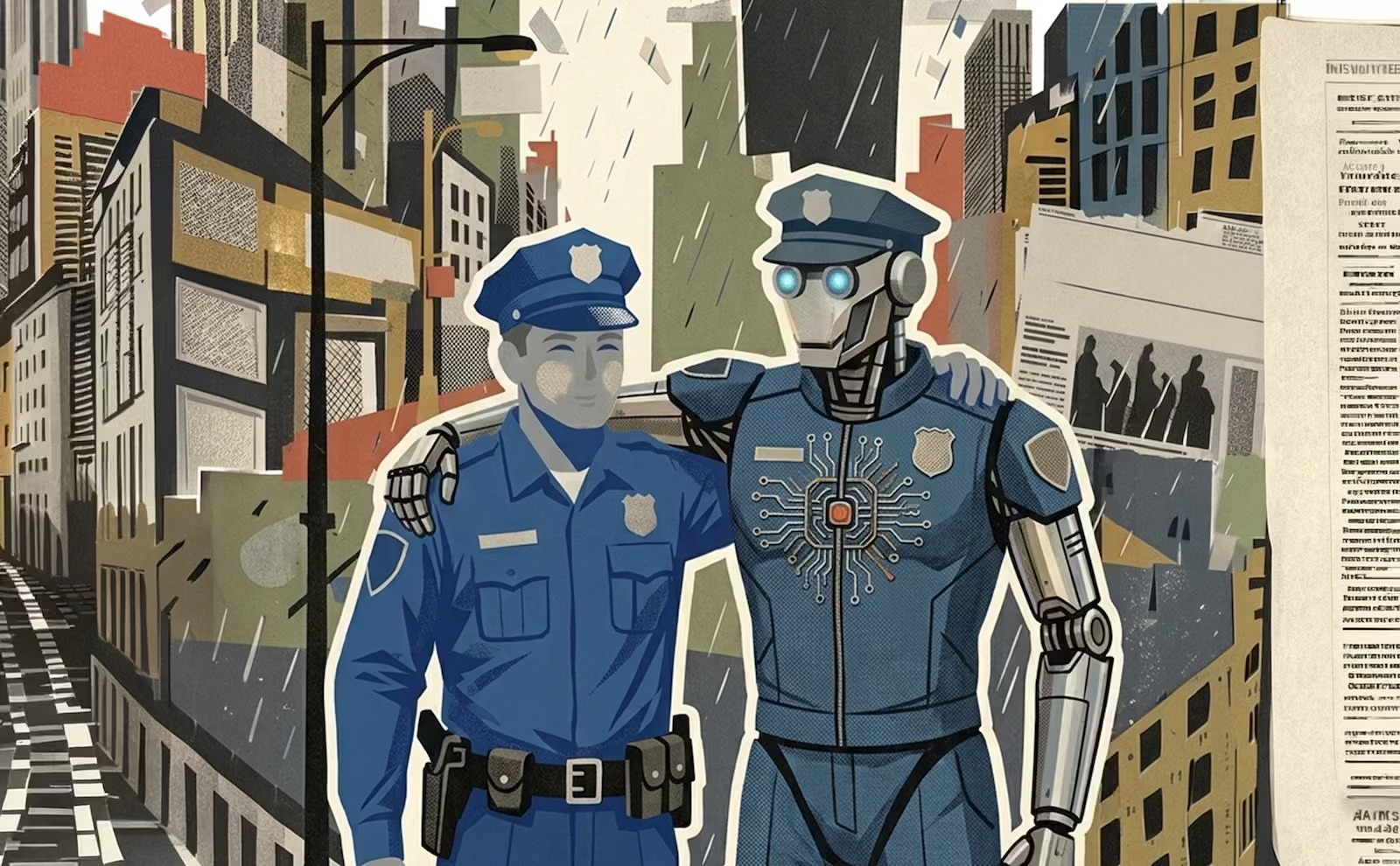
Buddy Cops
Why Humans and AI Always Get Their Guy

It is 2 AM. A security operator sits alone in front of a wall of screens. Thirty camera feeds. All quiet. All still.
Here is the problem. After about 20 minutes of watching screens like that, a person misses up to 90% of what happens on them. We are just not built for it. The one moment that matters slips right past.
Psychologists proved this years ago. In one famous study, viewers watched a video and counted basketball passes. Halfway through, a person in a gorilla suit walked into the frame and thumped their chest. Afterward, about half the viewers swore they never saw it. They were so locked on the ball that a gorilla turned invisible. Scientists call this inattentional blindness.
This is the gap that artificial intelligence promises to fill. But before we decide whether to trust it, we should ask a simpler question. What is AI, really?
A Quick, Honest Explanation
Most people meet AI through tools like ChatGPT. They are called large language models, and under the hood they do something almost boring. They predict the next word. You type a few words, and it guesses the next, then the next. That is it. No understanding. Just a very fast, very good guess.
The AI used in physical security works a little differently. It does not predict words. It predicts patterns in what a camera sees. Show it enough video and it learns to tell a person climbing a fence from a plastic bag blowing across a lot.
This AI no longer lives in a far-off server room. It continues to move onto the hardware itself. Cameras and field units carry the brains inside them. They watch, judge, and flag a problem right where they stand, then call a human. That continued shift, AI baked into the device, is quietly the biggest story in security.
Good AI systems do not replace your people. They augment them by pointing them toward the moments that count. Think of AI-enabled hardware as a teammate that never blinks. Not a replacement for judgment.
The real choice was never robots versus guards. It is whether to hand your team smart hardware that helps them see and act with extreme efficiency.
Why So Many Leaders Are Saying “Yes”
The pull toward AI is not hype. It is a hiring crisis and some hard math.
The security industry cannot keep people. Guard turnover runs between 100% and 300% a year. Many firms replace their entire team once or more every year. Pay is low. Benefits are thin. Nearly half of guards have no health insurance through work. When a better job shows up, people leave. You cannot build security on a revolving door.
The cost story is just as loud. Covering one post around the clock takes three to four full-time guards, once you count shifts, vacation, and sick days. In a big city, that one post can run $200,000 to over $300,000 a year. Smart cameras with remote monitoring cost a fraction of that. Many properties cut their security spend by 40% to 70%.
Now add the attention problem. A smart camera does not get bored, and it watches every feed at once. For a leader facing empty shifts and a tight budget, AI-enabled hardware is hard to ignore.
Why “Yes” is Not the Whole Story
But hardware is only as good as the AI inside it and the human behind it.
In October 2022, a student walked into a high school in Utica, New York. The school relied on an AI weapons scanner built to catch threats. It missed a seven-inch knife. That knife was used to stab a student. Turn up the sensitivity, and the same scanner flagged laptops, lunchboxes, even a bag of chips as a gun. The FTC later took action against the maker for overstating what its system could do. Smart hardware that promises everything and cries wolf can be worse than none at all.
Bias is the other trap. Facial recognition does not work the same for everyone, with higher false match rates for women, older people, and people of color. That is not just a statistic. It has a face. In January 2020, police arrested Robert Williams in his Detroit driveway, in front of his wife and daughters, after a camera matched his face to a watch thief. The match was wrong. Porcha Woodruff was arrested for carjacking while eight months pregnant. The suspect on camera was not. More than a dozen people, most of them Black, have been wrongly arrested this way. The machine guessed, and people trusted it without checking.
The law is watching too. Face scans count as biometric data, and Texas just won a $1.4 billion settlement over face data collected without consent. Skip clear permission and a real policy and the legal risk can swallow any savings.
The Smarter Middle Path
So, to AI or not to AI? That is the wrong question. The better one is how.
The best security programs do not pick AI or people. They blend them. The hardware does the tireless watching. People make the judgment calls and decide when to act. Keep a person in the loop on every real decision and you get the speed of the machine with the wisdom of a person.
For years, the AI story was all software. Smarter algorithms. Better analytics. Fancier dashboards. The real breakthrough now is putting that intelligence into rugged hardware you can drop anywhere, with no permanent power or cable required.
A new class of security units is rewriting the rules. They roll onto a site and go live within the hour. They run on solar and cellular. No trenching, no grid hookup. They pair on-site cameras and edge AI with live human monitoring, so the device watches everything and a real person steps in when it counts. And they cover ground old-school guarding never could. Construction sites. Parking lots. Remote yards. Corners that never justified a full-time post.
That is the real promise. Not replacing people, but extending them. One operator backed by smart cameras can now cover ground that used to take a dozen guards in places that used to have none. The labor crisis and the budget crisis ease at the same time.
AI is not a magic guard, and it is not a monster to fear. It is a tool. Paired with hardware built for the real world and a human hand on the wheel, it can fill the gaps that have stretched security teams thin for years.
Get the Latest Articles
Unlock exclusive insights from the world of intelligent site management and proactive security. Subscribe to ELEVATE to get our latest featured articles, expert interviews, and tactical insights delivered right to your inbox.