Introducing GuardGate: Reliable Access Point Security

For many facilities, the biggest barrier to reliable access control isn't the technology, it’s building and manning it. Traditional security models demand expensive guard shacks that cost a fortune to construct and even more to man 24/7, often exceeding hundreds of thousands of dollars annually per location. For businesses leasing their space or managing massive properties with minimal infrastructure, building a permanent physical outpost isn't feasible or scalable.
This discussion explores how GuardGate removes these physical barriers, providing a remote access point control that offers security without the six-figure construction costs or the logistical nightmare of staffing a remote post. This product is built to be rapidly deployable with little to no maintenance. Find out why companies are excited about this new product and how it is already saving them time and money.
Featured Speakers

Ash Roberts
Ash Roberts is a Staff Product Manager at LiveView Technologies (LVT), overseeing a diverse portfolio that includes Alert and Video Management, GuardGate, SafeNow, and the LVT Mobile App. With over a decade of product management experience across FinTech, business communications, and peer-to-peer recognition platforms, he specializes in dissecting foundational user workflows to pinpoint root problems and drive collaborative solutions. Ash holds a B.S. in Psychology from Brigham Young University and is currently pursuing a Master’s in Applied Artificial Intelligence at Utah Valley University.
Efficiency Without the Infrastructure
Traditional access control has forced a compromise between overhead and risk. If you want a manned gate, you’re looking at upwards of six-figures a year in staffing costs or months of red tape, permitting, and construction to build a permanent shack. For many sites, the math doesn’t add up, leaving your assets vulnerable with a security solution that costs more than the problem it’s solving.
GuardGate changes the equation, delivering the deterrence and documentation of a manned post without the ballooning price tag or construction headaches.
What we cover:
- The ROI Pitch: Why GuardGate is cheaper and more effective than a traditional shack.
- Success Story: Hear about the ROI early users are projecting.
- The Ecosystem: How GuardGate plugs directly into your existing LVT setup.
- The Package: A full breakdown of what’s included in the GuardGate offering.
Full Transcript
Robin Dich:
All right. Thanks everyone for joining. Let's get started here and as people trickle in, but again, want to thank everyone to being here today. This is a topic and issue that a lot of businesses are dealing with right now, whether it's a gate, Guard Shack, access point control for vehicles and people. It's a key piece of the security blueprint when it comes to businesses. So we're really excited to give you our insight on what we've learned and how GuardGate will be able to play a role in that as well. So I want to introduce you to our product expert, Ash Roberts. Ash is our staff product manager that oversees GuardGate and SafeNow. So Ash, thank you so much for joining us today.
Ash Roberts:
So excited to be here, Robin. Thanks for letting me join.
Robin Dich:
Yeah. And before we dive into all things access control and gated related topics, just how much research have you and your team done on just the industry itself when it comes to access control?
Ash Roberts:
Yeah, we've been looking at access control now for about two years. And so we've done a lot of digging. We've talked to a lot of different customers about their access control needs. And particularly, as you will see today, as we dive into GuardGate today, you'll see that our focus has been on remote access control in places like distribution centers or drop yards and construction sites and those kinds of things. And so that's really what the research we have done has focused on is what is out there, what problems are there to be solved? How are our customers solving those problems today? And so we're excited to kind of dive into this and talk you through what we've done and the problems that we're trying to solve with this product.
Robin Dich:
Yeah, absolutely. Really excited for that. So let's talk about why there's a need for a guard shack. And as we've discussed, it's not just a guard shack, it's just gated security or just being able to control point of entry and exits as well.
Ash Roberts:
Yeah. And a lot of these locations that we've worked with our customers on in these drop yards, distribution centers, construction sites, there's a need to be able to reduce theft or stop theft and also just have some sort of eyes or something on the location. And so that's why they want to put in a guard shack. They want to put in a gate to be able to prevent or deter people from coming into the locations that have often pretty expensive items on there. And then what some people don't realize is that there's also some liability aspect to that as well of, well, from an insurance perspective, from a compliance perspective, there are things that need to be in place to be able to have the reduction in cost of insurance and that kind of thing, the liability. And so there's quite a few different reasons why our customers have and want those guard checks in place.
Robin Dich:
Yeah. And when we talk to some of these customers and prospects, these locations are in pretty rural areas or they're not close to a lot of things. So being able to keep track of who's coming in and out is really important for those type of locations and businesses.
Ash Roberts:
100%. And often they don't have that. They either have a guard that's there and maybe they're taking some notes of who's come in and who's gone out, but often they don't have any insight into what is happening on those remote properties.
Robin Dich:
Yeah. So while there is a need, unfortunately there are problems with traditional gated security. And as you can see on the top infrastructure and guarding costs. So before we dive into these problems, I want to give the audience an opportunity to win a gun save from LVT because in your research, you have come up with an annual OPEX cost for a guard shack with onsite guards. That is for one year, it's a pretty large cost, pretty shocking to me when I first saw it. So whoever in the audience can guess the closest number to how much it costs for one year, we'll send a gun safe to afterward. And you'll have a couple minutes as we discuss before we reveal that big number. So type in the chat what you think and whoever's closest we'll send a gun safe to. So when we talk about problems, there is a lot when it comes to cost and then time to build. Those two are pretty obvious, I'd say, when you're trying to start building these things, right?
Ash Roberts:
Yeah. And I think there's a lot of costs that people forget about, right? And so from an annual perspective of infrastructure and guarding, I'm going to drop a few hints as we go through to try and see if I can get you kind of to that number. But as you look at a traditional gated guard shack, right, you've got a lot of costs that people often forget. So when it comes to infrastructure costs, and we're going to dive a little bit more into this, but again, thinking about in these remote locations, that changes from a cost perspective, guarding costs.
You've already mentioned the time to build it, right? What happens in the meantime? You've also got human error that takes place with some of these traditional guards. I mean, we all know some of those really good, really, really good guards that kind of know the area, they know the people going in and out, they are very vigilant and they're very few and far between. We've spoken to some customers who've had their guards like playing Xbox, right? We walk into the guard shack and all of a sudden there's a full surround sound system and an Xbox there for them to be doing something at night, as well as scrolling through social media and those kinds of things.
Robin Dich:
Sorry,
Ash Roberts:
Go ahead, Rob.
Robin Dich:
Yeah. When it comes to guarding, when we talk about it too, it is just human nature to get distracted when you're trying to stare at a camera for hours and hours to look for something when most of the time nothing's happening, but when something does happen, that's the most important part. And then there's the boredom of it all, right? There's hours of a lot of traffic coming in, then there's hours where there's not. So when we have technology to be able to help these humans not miss those things, I think that's when they need to take advantage, right?
Ash Roberts:
100%, yeah. And we give them a hard time, but we're all humans. We all make mistakes, right? And so we kind of give guards a bad rap there. But included in some of these problems, in a lot of the customers that we've talked to, there is a long lead time to fix or repair things. And so you've got this maintenance and uptime costs that come into play as well. I mean, we spoke to a customer who talked about three to six months. And the six, seven meme that we've got going, I tease my kids all the time that they've stopped that now because I think the adults have got too involved in six, seven. But it's funny because we start talking about this three to six months to fix a gate that's broken or something like that. It's becoming really real that three to six months in some of these remote locations.
Robin Dich:
Yeah, absolutely. And as we dive into the costs of these gated security products or buildings, when we talked about the annual OPEX costs for Guard Shack and onsite guards, and we're seeing some of these numbers come in, these guests, a hint, if you want to continue to guess, it's six figures. So maybe that's a little bit of some people. There are some already in some kind of close, but this setup cost, we're not even including that part in this number coming up. We're not even including the setup costs in the operational part of how much it costs per year.
Ash Roberts:
That's right. So when it comes to this traditional security, if we want to call it that, you've got your physical infrastructure, right? So you've got that up here with the $4,200 number here.That's your guard shack, that's your trenching, that's the HVAC. And then people don't often realize this, but as soon as you build a guard shack, they have to have somewhere to go to the bathroom.
Ash Roberts:
And
Ash Roberts:
So you've got bathroom and electrical, and it just starts adding up. I mean, we had, at our security summit, we had a customer tell us that they had been quoted $800,000 for trenching, and then being able to set up the actual guard shack and the barrier gate in one of these remote locations.
Robin Dich:
Yeah. And you talked about it. When we're showing these numbers, this is on the conservative side of numbers when you look at it, because permits can change per location, state, area. The trenching can change depending on how much needs to be done. Even the gate and barrier hardware, that is average of decent gate and barrier hardware, right?
Ash Roberts:
Yeah. I think I just saw somebody comment like, "I want to know how they do that for that much." Exactly. This is very conservative. So we're looking at this from a conservative aspect as we look at the problem that we're trying to solve here. And then don't forget about the good old permits that
Ash Roberts:
Sometimes
Ash Roberts:
We don't ... In some of the locations that we talk about to our customers, that they want some infrastructure in place or they want some sort of access control in place. These are remote locations that are leased or rented, and so they can't even do that there. They don't want to get permits there. They don't want to put this infrastructure in place there. And so that's another aspect to consider as we looking at these numbers.
Robin Dich:
Yeah. And permits aren't a guarantee either.That's the tough part too. It just all depends. And so the next slide, last second for guesses, I'm excited to show this big number. There's a few people that are really close. So I'm about to reveal Ash's research here. So all right, we got one more guest there. All right, let's reveal it. $236,800 total annual OPEX costs when it comes to Guard Shack with onsite guards, nearly $240,000 per year. That number, I'm no finance person, but I only work in marketing, but that's a lot of money.
Ash Roberts:
Yeah. It's a staggering amount when you start to realize that this is just for a single location. Try and multiply that number by three or four when it comes to a larger location that has multiple ingress and egress points. And all of a sudden you're in the millions of dollars just from a guarding perspective. And so this, to me, this is a kind of a wild number to look at from a, okay, this is guards, this is four to five guards, this is twenty four seven security in that place. It's a lot of money for our customers to deal with.
Robin Dich:
Yeah. It's a lot. And when we break down these costs here of why, it really isn't that shocking when we break it down to this, right? Because we take a look at the maintenance, the insurance, when it comes to annual guard costs, we did about $25 an hour for a guard onsite twenty four seven. So when you put it all together, it really shouldn't be that shocking, but that number, like you said, is just for one location.
Ash Roberts:
That's right. Just for one. And then the other things that people often forget is upkeep and maintenance costs, insurance costs. And those of you are in this industry, 100 to 300% turnover in guards a year, right? And then you've got your operating costs and then the three to six months. We spoke to so many people at ISC West and I started teasing them because I was like, "I bet it takes about three to six months for you to get your gate fixed." And they were like, "How did you know? " One of our customers, in fact, Robin, I wanted to mention this, one of our customers is actually training their security operations team. They're getting them certified to become gate technicians
Ash Roberts:
So
Ash Roberts:
They can fly them out to these remote locations to try and fix some of their problems out there. But that's how bad the time to repairs is and problematic it is for our customers.
Robin Dich:
Yeah. And when you talk about time for repairs, the reason why we didn't put a number on there is because it's really hard to quantify because when a gate is down, you're losing money as a company. That means one access or exit entry point or exit point is down. So that means more traffic to one or a location has to change. There are a lot that come with this. So three to six months is a big hindrance on most companies, I'd say, right?
Ash Roberts:
Massive, massive. And it's a problem because now you have the little visibility that you did have, the little bit of control that you did have in those locations, you just don't have it anymore.
Robin Dich:
Yeah. So that's why today we want to introduce GuardGate. We think this is a great time. We've listened to all the issues that our customers, prospects are dealing with, what the industry is trying to deal with, and that's why we believe GuardGate can solve a lot of those issues today.
Ash Roberts:
Yeah. And we're really excited to talk about this. GuardGate is an option for customers to use in remote locations, locations where they don't want to put up infrastructure and they can put this out there and it can be immediately accessible. It is remote controlled. So you can be a thousand miles away and be able to speak to the individual that's trying to get in, gain their information, and we'll talk about these details a little bit more later on, but we're excited about what this means for our customers and the reduction in costs that it could mean for them as well.
Robin Dich:
Yeah. And to the audience that's here, if you have any questions as we go through some of the details about Guargate, please put them in the chat. We'll address those as they come in and as we see fit, and we'll make sure to get to those by the end of this discussion as well. And Ash, when we were developing GuardGate, one of the pivotal players was our customer Home Depot that helped us understand what they needed from a product like GuardGate. So when we had Home Depot at our safety and security summit, they discuss how the development of GuardGate and what they're doing with it now. And one problem that they needed to solve was having something, a reliable access point at large locations in the middle of nowhere with very little infrastructure for cameras and maybe one guard on their location. So I wanted to play a little bit of their testimony and then we can talk more about the Home Depot success story afterward.
Ash Roberts:
What we were looking to do is how do we control that access, especially in the middle of the night and the things that we could do. So the problem was, one is how do we ensure we have the best standards from a security standpoint, reduce our exposures, and then how do we also be able to get an entrance and an exit? And in our facilities, what we have is we have not only over the road drivers that are coming through, which it might be their first time coming through, just an over the road. We also have a group, what we call switchers or yard dogs that are going back and forth from our main site to an offsite to pick up trailers coming back and forth. And those lots could have either empty trailers that are stored there or they could have merchandise and products stored on them, so depending.
So our idea was we needed to secure these spots and how could we do it in an economical way, plus a way that we could do it a lot quicker, right? So if we needed to stand up a yard within 24 hours, we could stand up a yard within 24 hours and get a unit there to do it. What we have done in this case is we run a guard gate and then we're also running additional cameras. And for me, this is where it becomes a, what's in it for me. The cost savings for me really is the reduction of a guard force being able to use the people that we have on site on our main sites to be able to help us regulate. It's about a 53% cost savings for me today.
Robin Dich:
Yeah. So 53% sorry, let me get to the next one. 53% cost savings for me today. That obviously is the big standout when it comes to what Jeremy Wallace, the supply chain AP director for Home Depot had to say. That in itself, I mean, we talked about this. If we ask anyone in the audience right now, what would they say to 53% cost savings, right?
Ash Roberts:
Yeah. I mean, amazing. Everybody is under pressure right now, and we hear this often as we go and talk to our customers. They're under pressure all the time, number one, to prove ROI, and number two, to reduce costs. And so that's a perfect way that Jeremy summed that up of a significant cost savings using GuardGate rather than their previous systems that they had in place.
Robin Dich:
Yeah. And one thing that Jeremy was mentioning was putting their guard force in the right places. One thing with the MSU for LVT, with GuardGate, it's a force multiplier. We don't want someone stationed in one place staring at cameras. We want that guard to be in the right areas and deterring crime or making sure that they can go investigate an incident or suspicious activity. We want them in the right place, in the right position, because if they're stuck on one location, it's hard for ... Then there's exposure to all the other parts of the location, right? It just frees up the guard and then frees up the cost for companies.
Ash Roberts:
Yeah. And it allows you to centralize your operations. There's a lot of benefits for centralizing operational pieces. It also allows you in some way to centralize your security so that you have people coming in and going out and able to control that remotely, and then if needed, you can get a guard out there.
Robin Dich:
Yeah. You talked about it could be thousands miles away. I believe Jeremy, when he was speaking about it, said that they get buzzed into a center about 50 plus miles away. So it really does give you that flexibility.
Ash Roberts:
Lots of flexibility. Yep.
Robin Dich:
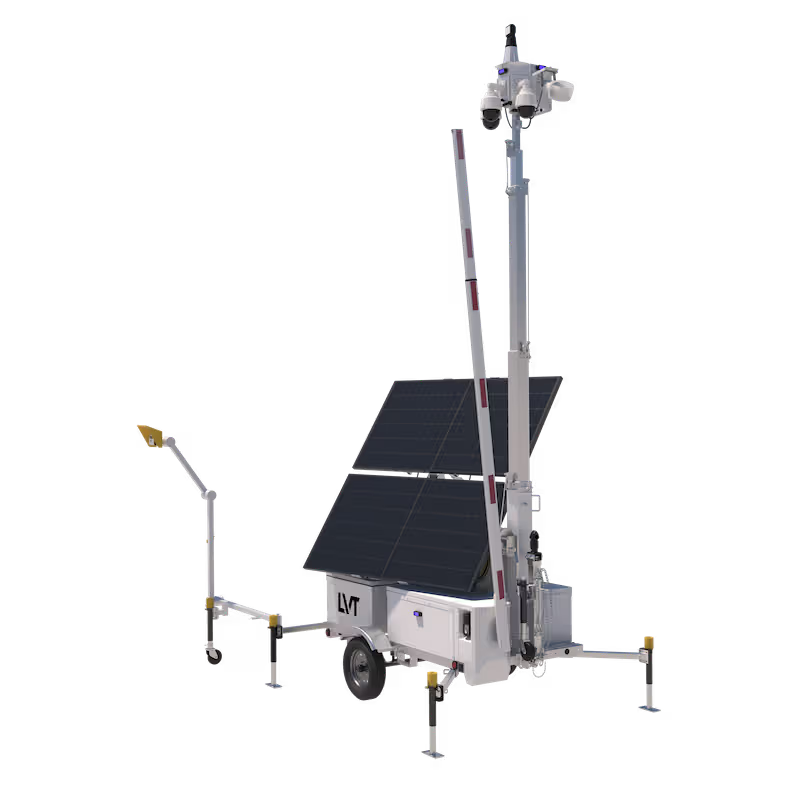
Absolutely. So let's talk about it. Let's talk about how GuardGate operates. Let's bring you back to that first picture we showed you of our GuardGate product.
Ash Roberts:
Yeah. So as you can see, this is our mobile security unit, tried and tested mobile security unit that is self-contained. It has its own power. It has its own solar to recharge that power. We've got really sophisticated cameras on there as well. And then what we've done is we've gone, okay, well, what else can we add to this with the power constraints that we have to be able to enable this access control? And so you can see we've added a gate arm on there, and we'll talk a little bit more about those details, as well as an intercom. And we added that specifically so that we could have that remote access, right? So there's three ways to actually open the guard gate. You have an actual physical clicker that you can do while you're on site, but you also have the ability to receive these remote calls as people are coming in.
You can get their bill of lading, you can get there, as you can see in this image here, their license. This is our interface, this is our command center, which allows you to then take the notes that you need to take the notes for that, and then you can resolve and open the gate. Again, this is just showing some different kind of images of the other cameras that are available to the operator so they can get a little bit more of a situational awareness of what's happening as this person's coming on
Robin Dich:
Site. Yeah. We have a question from Nick about how does the system update with in and out activity? Is there a way for it to keep track of that?
Ash Roberts:
How do they ... Sorry, I missed that little-
Robin Dich:
Is there a log that keeps
Ash Roberts:
Track of activity? Yeah. So when a gate is opened or closed, it logs in our system and so somebody can come back in there and see exactly who's gone in, who's come out, the notes that has been written and there is an attached clip of the actual vehicle going in and out during those times. That's great.
Robin Dich:
Great question. Yeah. Super helpful, especially if you're not able to ... You're changing shifts, you're making sure looking back at logs for liability purposes, things like that as well. So that's great to know. So let's talk about the features on this guard gate.
Ash Roberts:
Yeah. So the physical features that we have, we have a 15 foot usable arm. The arm's actually about 18 feet long, but we like to use this term usable because only 15 foot of it is actually usable because of the outriggers that we have there that are stabilizing the system. So 15 feet from the outriggers, that covers a full lane of traffic and more and gives you that control aspect as people are wanting to come in and out of the location.
Robin Dich:
Yeah. And then we also have the intercom that's connected to it too.
Ash Roberts:
Yeah. So the intercom here, this is kind of a flexible intercom. So you can have it either up at cab height or down at sedan height. It gives you that flexibility to be able to determine that height as well as ... I think everyone knows this, who deals with these things, almost guaranteed that somebody somewhere is going to hit the thing. Whether they
Robin Dich:
Want to or not, right?
Ash Roberts:
Exactly. And so what we've done is because we've learned from our customers how important it is to get something up and running again, we've actually included what we call this breakaway, the intercom breakaway. It enables the intercom if it is hit to break away without actually braking, and it's very simple to just pull back into place similar to kind of your car
Ash Roberts:
Mirrors,
Ash Roberts:
If you want to use that as a reference, giving you that less downtime when it comes to the system.
Robin Dich:
Yeah. And I think this is just the last two slides. It just shows how much thought you guys have put into the solution itself when it comes to the breakaway enabled Intercom. Even the adjustable Intercom height, it's no longer trucks that come in and out of facilities. You have cars that come in, whether it's a place where employees have to go to, but people now drive their own cars when it comes to delivering assets to customers as well. So the fact that you have put so much thought into what you can do for the customer, it really shows just in these last two slides. And it really shows when it comes to this part of it all, right? This is the exciting part.
Ash Roberts:
Yeah. And we're pretty proud of this part as well. So this is what we call our toolless bidirectional breakaway arm. So we have an incredible software and hardware manufacturing theme,
And this actually was designed by our in- house hardware engineers. So what this allows for, it allows the gate to breakaway in both directions. But as we chatted with our customers, we started to learn that there are breakaway systems out there that we are not unique in breakaway systems. So let me get that out there. What we are unique in saying and learning from our customers is, oh, our employees actually aren't allowed in a lot of circumstances to put something back on if they have to use tools. And so we learned from that, we discovered a little bit more. We found out that this wasn't just one or two customers, this was quite a few customers. And so that's where this bidirectional breakaway comes from. If the gate is knocked off in either direction, it's as simple as picking it up and it details back into place and it allows the functionality to be back up and running really quickly.
Robin Dich:
Yeah. And to your earlier story about companies training their own employees to be able to go out and fix these, that is part of the cost, flying them out, training them. And even then, when this could take minutes to pop back in, it's going to take still downtime for people to get there and fix it as well. So this toolless bidirectional breakaway arm is going to be a real key to just being able to have that downtime at a minimum.
Ash Roberts:
Really
Robin Dich:
Excited about that. We have a few questions about clickers, unique codes for drivers while I believe that is coming, at some point is coming. And that's what's really exciting about GuardGate because as you and I have discussed, this is just the first piece of GuardGate. This is just the first iteration and you see some of these things on the screen, especially with LPR integration. We just partnered with an LPR company inside LPR to put on our MSUs and work with. So we are taking steps toward those real soon, right?
Ash Roberts:
Yeah. As you said, this is just the beginning, right? Yeah. LVT, we have an incredible team here that is iterating, already starting to iterate on the GuardGate product. And so this is our V1, this is just the beginning. We are looking at LPR integration to be able to easily open and close the gate depending on the license plate it reads. We're looking at card readers as well. We We're looking at keypads and we're also looking at other easy access technology. Let's just talk briefly about license plate recognition. One of the problems that we're trying to solve here is that not all states have the requirement to have a front license plate number.
And so what we've got to figure out is where and how do we put this behind the semi, right? We're looking at card readers. This is one of the major things that we had coming out of ISC West is, well, what about known drivers? We heard Jeremy talk about these switches, right? What about these known drivers who need to get in and out really easily? So that's where this card reader's coming in. We looking into this, we're looking into the options to be able to do this. We have actually built the hardware, something that we're also proud of. We built the hardware for the future, meaning
The hardware is built in such a way that it can actually have additional things like a card reader, like a keypad. It's built in such a way that we have additional POE cables and that kind of thing. And so we're excited about the future that we've built with GuardGate and the opportunities that we'll learn from you. That's why we have these webinars is to share with you the information that we've learned and the product that we have, but also to learn back from you of what else you're dealing with and how else can we improve this product to meet your needs.
Robin Dich:
Yeah. With GuardGate, with our MSU, with our new products, we just announced it. That is always front of mind is how do we scale this? We have the MSU that we've developed over years and it's only gotten better and GuardGate's just going to follow the same path is we have the functionality that companies need right now and now let's make it even better for them. We don't want to sell a product that's one done. Okay, it's over. I think that's something that LVT is really proud of doing. So really excited for these new next steps for GuardGate. And when we talk about other easy access technology, I think what's interesting is there's just technology out there that we are continuing to research to see if we can integrate it as well or if it makes sense for us.
Ash Roberts:
Yeah. There's new technology being developed all the time. And so LVT wants to be at the cutting edge of that new technology. And so we are already researching other easy access technology to be able to provide to our customers to make this just seamless for them to improve both their security and also their operational aspects in some of these locations.
Robin Dich:
So let's answer a couple more questions before we end. Sure. One, we compare these two questions together. How easy to break the arm? And then part of that answer is probably there's a reason because it's also a deterrence from vandalism and all those things as well, right?
Ash Roberts:
Yeah. So the arm is ... Let's get this out there. The arm is not a barrier. It is not there to prevent a vehicle going through the arm. They will get through the arm if they try. So the arm is wind rated to a 50 mile hour wind. And so it's deliberately built in such a way that if it is hit, it can be put back easily to maintain that presence of control. And so that's why we've built it the way we built it, is really deliberately to be able to deter people from entering a location. But also just remember that we have an intercom that is recording twenty four seven. We've got all the other cameras on the unit that is also recording twenty four seven. And so not only are we preventing, but we're also capturing everything that is happening on the site so that you have all the details that you need if an incident does happen on your site.
Robin Dich:
Yeah. And the MSU has proven as a deterrence itself. Before the deterrence features even activate, it's already a deterrence itself. So add on an extra physical deterrence that people can see. That's really powerful.
Ash Roberts:
Yeah.
Robin Dich:
And then we talked a little bit about the remote control work for the gate. Is that through our VMS? How does that work?
Ash Roberts:
Yeah. So there's three ways to open the gate. We have an option within our video management platform, our VMS, with the command center that you saw earlier where you actually can take the notes and then open that up. And then there's also a clicker. I think I might have seen, I don't see all the questions here. I might've seen like a range on that
Ash Roberts:
And it's
Ash Roberts:
50 feet on the range for that clicker. It could be more, but again, from a conservative aspect, we say 50 feet. Yeah.
Robin Dich:
Awesome. And what is great about GuardGate, as we said, there's going to be new additional improvements as the years go on. And so I know there's more questions about future plans, but we'll announce those when we get those and we're ready to do so. So thank you guys, everyone, for joining us today. If you're interested in GuardGate, please head to lvt.com/GuardGate and fill out our product interest form. From there, once you fill it out, we'll have an expert, one of our team members contact you, answer any other questions you may have about GuardGate and then talk to you about how it could work with your business or your needs and go from there. We really want to learn more, as Ash said. So even if this is just a call to discuss GuardGate and maybe what you hope it can do in the future for you, please let us know and fill out that form on that website.
But yeah, lvt.com/GuardGate. Ash, thank you so much for joining me today and discussing GuardGate. Thanks everybody.
Ash Roberts:
Thanks for joining. And hopefully we answered your questions and please let us know if you have any more.
Robin Dich:
Awesome. All right. Thank you everyone. Have a good day.
Ash Roberts:
Thanks. See everybody.

Test Out the Best Security Strategy
We offer a free consultation and a custom end-to-end security strategy for your unique situation. Connect with an LVT specialist to see if you qualify for a risk-free trial.
